
Two Tesla Wall Connectors: Power Sharing and Planning
Planning two Tesla Wall Connectors? See how Tesla group power management, panel capacity, parking, and current product support shape the design.
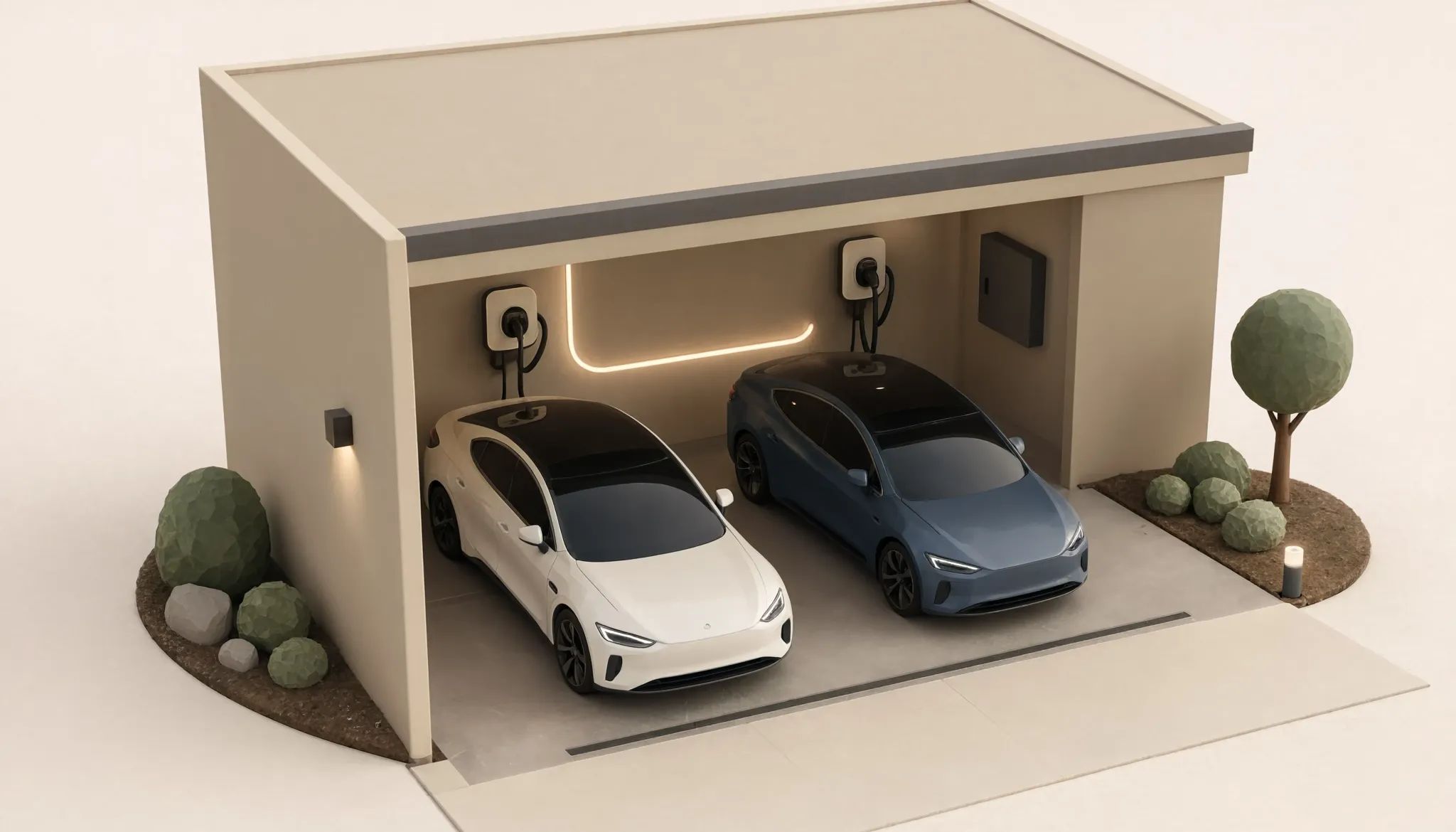
Two charging positions don't always require two full-output circuits. They require one plan for the vehicles, parking spaces, power available, and current Tesla setup.
That plan may use separate branch circuits or group power management. Tesla's current manual also lists a single-circuit daisy chain for Universal Wall Connectors.
These aren't interchangeable shortcuts. The product mix and site decide which paths deserve review.
If the product choice is still open, compare Tesla Wall Connector and Universal Wall Connector before treating the two-unit layout as settled.
Quick answer: what changes with two charging positions?
One Wall Connector serves one vehicle at a time. Two Wall Connectors create a system decision.
The installer now needs to know:
- How often both vehicles charge together, how much energy each needs overnight, and how long each stays parked
- Which Wall Connector models and generations are involved, including whether one unit already exists
- Where each vehicle parks, how each circuit could reach it, how much home power can go to charging, and which current Tesla power-management option supports the plan
The target is enough power for both vehicles without exceeding the home's set limit. That blocks two bad assumptions: two units always need a panel upgrade, or any two Tesla chargers can share one circuit.
Neither claim is safe.
Power sharing, load sharing, and group power management
Homeowners often search for “power sharing,” “load sharing,” or “load balancing.” Tesla's manual uses group power management for linked Wall Connectors that share a set amount of site power.
Tesla's Group Power Management Overview says the feature can link up to six Wall Connectors through unit-to-unit Wi-Fi. During setup, each unit gets an individual or shared circuit assignment and the group gets a total power limit.
The key control is simple: Tesla says the group's total output won't exceed the site's set power.
That doesn't mean each vehicle always receives the same amount. Available power can shift as vehicles connect, disconnect, or stop charging. A vehicle may also accept less than the Wall Connector can provide.
Three setup paths to discuss
A homeowner doesn't need to design the circuits, but should understand why the quote includes one setup and rules out another.
Separate branch circuits
Each Wall Connector may have its own circuit while both units run as a managed group. This can leave more power for charging when the home has the capacity, panel space, and usable routes.
Separate circuits don't mean unmanaged demand. Tesla's current group feature can still share power across linked units when the products and setup support it.
Shared circuits inside a managed design
Tesla's group manual also refers to Wall Connectors on shared branch circuits. That term belongs to a specific supported plan, not a reason to place two chargers on any existing circuit.
The electrician must confirm the Wall Connector models, circuit layout, current limits, and setup rules. An older unit, mixed pair, or different generation may change what Tesla supports.
Universal Wall Connector daisy chaining
Tesla's current daisy-chain instructions describe several Universal Wall Connectors on one branch circuit, set up as one group power-management system.
The same page says daisy chaining is currently supported only on Universal Wall Connector. That word matters: currently.
Don't extend that rule to standard Wall Connector, an older generation, or a mixed pair without current Tesla proof. “Daisy chain” isn't a name for every power-sharing install.
Start with the vehicles' actual charging need
The plan gets clearer when the household describes a normal week instead of asking for the largest possible number.
For each vehicle, record:
- Typical miles driven on a weekday
- The lowest state of charge that commonly reaches home
- Arrival and departure times
- Whether both vehicles usually charge on the same nights
- Whether either vehicle needs a short turnaround
- The highest AC charge rate the exact vehicle accepts
- Seasonal or work patterns that change the schedule
Two vehicles parked for ten or twelve hours may have more flexibility than two vehicles parked for three. One high-mileage driver and one low-mileage driver may not need equal charging allocation every night.
Tesla's daisy-chain page makes the same point. It says the unit count should keep the needed minimum power, and it links parking time to power available.
The homeowner describes the goal. The electrician checks which hardware and power plan can meet it.
No time promise belongs here. Daily energy use, battery state, weather, vehicle behavior, and the chosen setup can all change charge time.
Panel capacity and circuit routes belong in one review
The panel is only one part of the path. Two charging spots can also reveal route, space, and placement limits that a single-unit quote misses.
The review should cover:
- Main service and panel information, open breaker spaces, and other large loads
- Current solar, batteries, backup hardware, or generators
- The distance from the panel to both parking spots, including finished walls, attic or crawlspace access, and outdoor routes
- Indoor or outdoor exposure, mounting surfaces, and impact protection
- Links between Wall Connectors and the household's current and planned vehicle mix
Tesla's breaker and branch-circuit overview says group circuits may use a panel that serves other loads. A separate load center may make sense when panel space is tight or the main power source is far from the units.
That is a design option, not a universal requirement.
A panel upgrade may enter the plan when capacity, condition, or space limits the design. It isn't the default answer for every two-EV home. If the review finds that issue, AltoService's panel upgrade service explains the separate work.
The U.S. Department of Energy's home-charging guidance says an electrician can check whether a home has enough power for Level 2 charging. Local and state rules apply, and the local office may require a permit.
“Austin area” doesn't identify one permit office. The specific address controls the jurisdiction and utility questions.
Placement changes the system
Real homes may have side-by-side spaces, tandem parking, detached garages, carports, driveways, or one indoor space paired with one outdoor space.
Map both vehicles before choosing unit locations:
- Park each vehicle in its normal orientation.
- Mark the charge inlet location.
- Trace a cable path that doesn't cross a regular walkway.
- Open vehicle doors, garage doors, cabinets, and gates.
- Check whether the cable can be stored without resting in a travel path.
- Note sun, rain, irrigation, drainage, and vehicle-impact exposure.
- Measure the likely circuit route to each position.
A unit placed for today's vehicle may be poor for the second. A central point may improve reach but create a walking hazard. Split locations may improve daily use but make circuit routing harder.
Set up the Wall Connectors as a system
Mounting two units doesn't create power management by itself.
Tesla's group manual gives setup steps that assign each Wall Connector to a circuit and set power for the linked group. The feature also depends on unit-to-unit Wi-Fi.
The installer should verify:
- Supported Wall Connector models and generations
- Current firmware requirements
- Network and Wi-Fi conditions
- Individual or shared circuit assignments
- The total power limit
- Vehicle access settings, if used
- Correct operation with one and two vehicles connected
- The records provided to the homeowner
Tesla can change firmware, Tesla One steps, network limits, and supported product sets. Check those details in Tesla's current manual during design and final setup.
Texas requires a licensed electrical contractor for nonexempt work. The Texas Department of Licensing and Regulation provides the rule and license search.
Can two Tesla Wall Connectors use the same circuit?
Sometimes, under a current Tesla-supported design. Never as a blanket rule.
Tesla's manual lists a single-circuit daisy chain for Universal Wall Connectors. The units must run as one group, and Tesla currently supports this path only on Universal Wall Connector.
That evidence doesn't approve every pair of Tesla charging products, every mix of standard and Universal Wall Connectors, an existing circuit, an older product generation, a layout outside the current manual, or a home without a site and load review.
The safe answer depends on the product and date. Confirm the part numbers, current instructions, and site plan before treating a same-circuit option as available.
Tesla product and installation sources in this article were last checked August 5, 2026. Verify the current group power-management manual for the exact products before design and commissioning.
Common questions
Can you install two Tesla Wall Connectors at one house?
Yes, when the products, power plan, placement, and Tesla setup fit the site. The review should treat both vehicles and parking spots as one system.
Do two Wall Connectors require a panel upgrade?
Not always. Existing capacity, panel space, hardware condition, other loads, circuit routes, and target power decide whether panel or service work enters the scope.
Can standard and Universal Wall Connectors be grouped together?
Don't assume they can. Tesla's supported product sets can change. Check the models, generations, firmware, and current group manual before planning a mixed group.
How many Wall Connectors can share allocated power?
Tesla's Group Power Management Overview accessed on August 4, 2026 says up to six Wall Connectors at one site can share set power. Confirm the current limit and product mix before design because firmware and Tesla's manual can change.
Does each EV receive equal power?
Tesla's general group feature keeps the linked Wall Connectors within the site's allocated power. For the current Universal Wall Connector daisy-chain configuration, Tesla says available current is redistributed equally when a vehicle connects or disconnects. Confirm the behavior for the exact Wall Connector models and configuration.
Request a two-EV installation assessment
AltoService installs Tesla products and specializes in home EV work. A useful two-EV review covers charging needs, parking spots, circuit routes, panel capacity, other loads, product models, Wi-Fi, and current Tesla power-management options.
Review AltoService's Tesla charger installation service, check Austin-area service coverage, then send the two-vehicle details.
Include both vehicle models, normal parking spots, expected charging overlap, location photos, closed-panel photos, and the part number for any Wall Connector already in place. Confirm final support and setup against Tesla's current manual for the specific home.