
Home Battery Backup in Austin: Battery, Generator, or Both?
Compare home battery backup and standby generators for an Austin home by reviewing priority loads, outage goals, fuel access, solar, and site constraints.
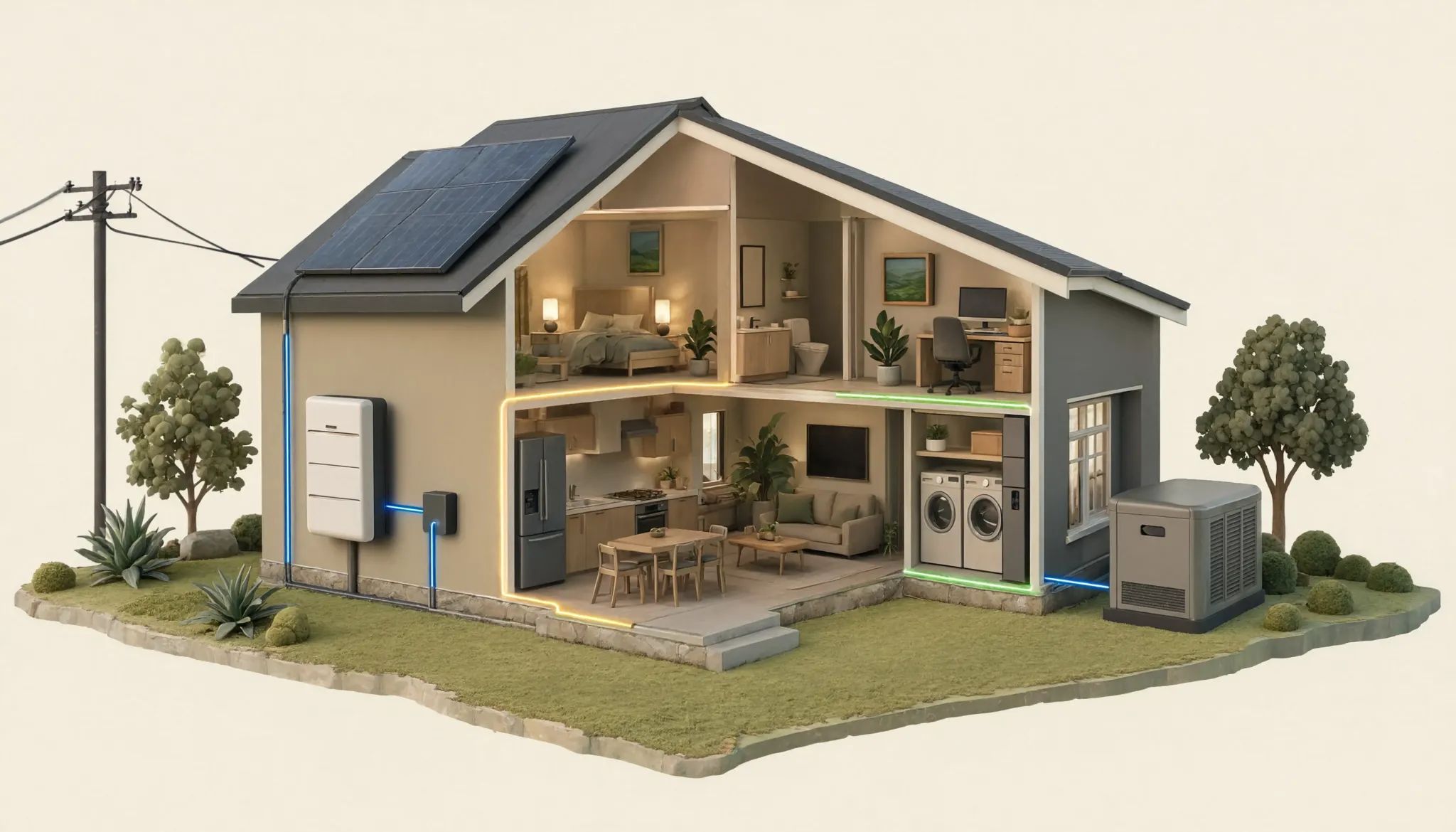
A backup power plan gets clearer when you start with the outage, not the equipment. List what must keep running, how long it needs power, and which comforts can wait.
Those answers help an Austin area homeowner compare a battery, a standby generator, or a design that uses both. They also show what the home's electrical system must support.
No option fits every home because each uses a different power source and works differently.
Start with the outage you want to manage
Begin by sorting household loads into three groups:
- Must stay available. This group might include a refrigerator, lights in key rooms, internet, medical equipment, or a well pump.
- Useful but flexible. This group could include selected outlets, cooking equipment, or one cooling zone.
- Can wait. Large or optional loads may not belong in the first backup plan.
If the plan includes medical equipment, keep a separate emergency plan for outages. A backup-power proposal is not a substitute for the equipment manufacturer’s guidance or emergency services.
This list is more useful than saying “whole home.” That phrase can mean every load stays available, or that all circuits connect to the system but need careful use during an outage.
Next, describe the outage itself because a short break in service and a long one place different demands on a system. Note whether someone can manage loads, whether the household accepts fuel use, and which systems must restart on their own.
You cannot predict every outage, but you can define the conditions that the design needs to handle.
A practical battery-versus-generator screen
- Battery: Ask which circuits are protected, how much usable stored energy the proposal assumes, what can recharge it during an outage, and which runtime assumptions depend on load management.
- Standby generator: Ask about the permanent fuel source, automatic transfer equipment, protected loads, service needs, and site rules for the selected model.
- Combined design: Ask how the battery, generator, controls, charging path, and transfer sequence work together. Compatibility must be designed; you can't assume it from the product categories.
This comparison is about permanently installed standby generators. A portable generator is a different safety case: never run one indoors or connect one directly to house wiring.
Compare stored energy with fuel-based power
Generac says its PWRcell 2 battery can charge from solar panels or the grid. It holds that power until it is needed, then uses stored power to back up a home during an outage. Generac also says the system manages non-essential loads to save battery power and extend backup time. See Generac's current solar battery storage page.
This product example shows why a battery proposal should name the loads it will support. Ask which circuits the design covers, how it handles large loads, and what it does as stored power gets low. If the home has solar, ask how the proposed design works when the grid is down instead of assuming the panels will keep every load running.
Generac defines a home standby generator as a permanently installed system that automatically supplies electricity during a power outage. Its page says most home standby generators use natural gas or liquid propane. Natural gas models connect to a gas utility line, while propane models use a tank at the property. See Generac's current standby generator overview.
These Generac examples compare stored power with fuel-based power, but they do not prove how every product will work in every home. A useful proposal should state its assumptions about backup loads, run time, fuel, charging, and load control without promising a fixed result.
For a deeper fuel-based planning checklist, read Planning a Standby Generator Installation in Austin.
Investigate the site questions instead of assuming the answers
Homeowners often compare noise, exhaust, equipment location, and upkeep. Treat each point as a question about the project, not as a claim that applies to every product.
For each design, ask:
- Where do the rules and instructions for the chosen system allow the equipment to go?
- How much sound could reach the property line, a bedroom, or a neighbor's home?
- Which air flow, exhaust, or site conditions need review?
- What checks, tests, or service does the equipment need?
- How will a service worker reach the system?
- What happens after a long outage or a long period without use?
The answers depend on the address, equipment, property, and rules. A simple chart can't determine this from product type alone.
For either path, use the selected manufacturer's current instructions and confirm equipment compatibility, site clearances, permits, utility requirements, and applicable codes for the property.
Review the electrical path before choosing equipment
Backup power must connect to the home as one system, so the existing panel, service equipment, backup connection, and load plan all matter.
An electrical review may need to answer:
- Which circuits could receive backup power?
- Can the current panel support the proposed connection?
- Does the project have room for the needed equipment?
- Does the home have faults or damage to fix before adding backup equipment?
- How will the design keep large loads within its limits?
- What will the system do when utility power returns?
A project does not always require a panel upgrade, but an electrician still needs to review what is present. If that review finds an existing fault or damaged equipment, discuss it as a separate electrical repair.
Generator connections also need a clear link to the house wiring. Austin Energy says only a licensed electrician can connect a generator to house wiring with a transfer switch. Use TDLR's public license search to check current contractor status; AltoService's Electrical Contractor license number is 39963.
A combined design is another option to evaluate
A homeowner can also ask whether a battery and generator could work together. This option may be worth reviewing when the outage plan has two jobs, such as quick support for selected loads and a separate plan for a longer outage.
That possibility does not prove the equipment will work together. The chosen equipment, controls, charging path, transfer plan, load controls, and product instructions must all match. The design also needs a clear order for utility loss, equipment startup, a power-source change, and the return of utility power.
Ask the electrician to explain that order in plain language. Before choosing equipment, note any claim that depends on every major load running at once, steady fuel, ideal weather, or constant homeowner help.
A combined system can add choices and connections. Review one only if it helps solve the outage problem you defined.
Confirm the authority for the property address
“Austin” describes a broad service area, not a single permit office or electric utility. Austin Energy says about half of its service area is inside Austin city limits, while the rest reaches parts of other communities and counties. Its service area map shows why homeowners should check the utility and permit authority separately.
For projects within its scope, the City's current standalone permit guidance says the SB 1202 process covers home backup power systems up to 600 volts, including generators and batteries, at one-family and two-family homes. The page says Austin Energy's auxiliary permit process stays the same. It also calls for a separate electrical permit and City inspections when the work requires a shutdown, plus a separate plumbing permit and City inspections for natural gas or propane work.
Those details apply only to the City of Austin process, not every Austin-area address. Confirm the utility and permit authority for the property.
Before contacting an electrician, gather:
- The property address
- A list of must-have and optional outage loads
- Photos of the main panel and nearby electrical equipment, without removing covers
- Information about existing solar or backup equipment
- Any equipment already under consideration
- A note about possible equipment locations
Check AltoService’s service areas, then use the contact page to start the scope conversation.
Send the property address, the loads you want available during an outage, whether the home has solar, any equipment already selected, and photos of the main electrical equipment. AltoService can confirm service availability and the next scoping step.